


Launching a nutraceutical brand involves more than having a great product idea. One of the most important decisions is finding a reliable private label nutraceutical partner who can turn your concept into a consistent, compliant and market-ready product while supporting your brand as it grows.
Focusing only on the price may seem like a smart move, but it can overlook the quality and support your brand needs as it grows. Factors such as formulation expertise, ingredient quality, testing, documentation, packaging options, production capacity and regulatory support can have a significant impact on your brand’s success.
For businesses entering the Indian nutraceutical market, regulatory compliance is another key consideration. The Food Safety and Standards Authority of India (FSSAI) has specific requirements for health supplements and nutraceuticals, making it important to work with a manufacturing partner who understands the applicable regulations and product requirements.
Quick Overview
A reliable private label nutraceutical partner should demonstrate strong quality systems, relevant regulatory compliance, formulation expertise, transparent documentation and production capacity that can scale with your brand. In the long run, these factors can matter more than choosing a manufacturer based only on price.
Why Your Manufacturer Can Shape the Future of Your Brand
Your customers may see your brand name and packaging, but their experience ultimately depends on the quality and consistency of what is inside. If your manufacturer struggles with quality control, production capacity, documentation, or product changes, WHO’s Good Manufacturing Practices (GMP) provide guidance on maintaining controlled and consistent manufacturing processes.
The right private label supplement manufacturer can be more than a supplier. With support in formulation, manufacturing, quality control, packaging, documentation and scale-up, a reliable partner can help your brand grow smoothly and build a stronger product portfolio over time.
Explore = How Private Label Supplements Can Boost Your Wellness Brand
5 Factors to Check Before Choosing a Private Label Nutraceutical Partner
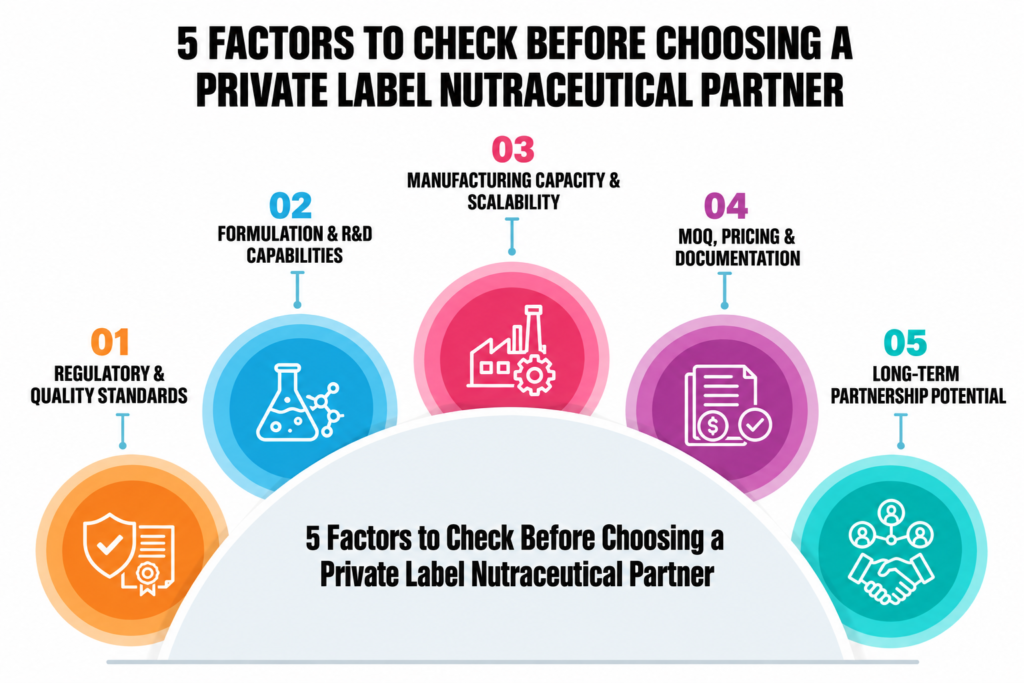
Choosing the right private label nutraceutical partner is about more than finding an affordable manufacturer. Choose a partner that understands compliance, delivers consistent products, maintains quality standards, and is prepared for your future growth.These five factors can help you make a more confident decision.
1. Check Regulatory & Quality Standards
Start by understanding how the manufacturer manages regulatory and quality requirements. For products in India, applicable FSSAI regulations should be considered during product development, labelling, and claims planning.
Look for a partner that can:
- Support relevant documentation, testing, and compliance requirements.
- Maintain consistent quality through proper raw-material and finished-product checks.
2. Evaluate Formulation & R&D Capabilities
A strong manufacturer should offer more than ready-made formulas. As your brand develops, you may need customised ingredients, dosages, flavours or delivery formats.
Consider whether the manufacturer can:
- Develop or customise formulations according to your requirements.
- Provide practical guidance on ingredients, stability, dosage and production feasibility.
3. Check Manufacturing Capacity & Scalability
Your first order may be modest, but your production requirements can change quickly if the product gains traction. A scalable manufacturer should be able to increase production without compromising consistency.
Ask about:
- Production capacity, lead times and ability to handle growing demand.
- Support for multiple SKUs and different nutraceutical formats.
4. Compare MOQ, Pricing & Documentation
Price and MOQ matter, but they shouldn’t be the only deciding factors. Consider the overall value, including testing, packaging, documentation, lead times, and inventory requirements.
Before partnering, clarify:
- MOQ, pricing structure, production timelines, and packaging options.
- Availability of COAs, product specifications, testing reports, and batch documentation.
5. Choose a Partner With Long-Term Potential
Think beyond your first product. If your brand succeeds, you may want to add gummies, capsules, tablets, powders, softgels, or other products. A versatile partner can support your brand as it expands.
Choose a partner that:
- Can help you introduce new products as your brand expands.
- Communicates clearly and can scale alongside your business.
Explore = Private Label Nutraceutical Manufacturing: Everything Brands Need to Know
A Practical Manufacturer Comparison Checklist
Before signing an agreement, use a simple scoring framework rather than making the decision based on price alone.
| Evaluation Area | What to Check | Why It Matters |
| Regulatory support | FSSAI requirements, claims and labelling guidance | Reduces compliance risk |
| Formulation | Existing and customized formulations | Supports product differentiation |
| Quality control | Testing, traceability, batch consistency | Protects product reliability |
| Certifications | Relevant quality and food-safety certifications | Provides evidence of quality systems |
| MOQ | Initial and future production quantities | Helps manage cash flow |
| Scalability | Pilot-to-commercial production | Supports business growth |
| Documentation | COA, specifications, testing and batch records | Simplifies quality and compliance processes |
| Delivery formats | Capsules, powders, gummies, softgels, etc. | Makes portfolio expansion easier |
| Communication | Dedicated support and clear timelines | Prevents avoidable delays |
| Long-term fit | R&D, new products and export support | Creates a stronger manufacturing relationship |
What Should You Ask During the First Manufacturer Call?
Don’t make your first conversation only about “What is your MOQ?”
You could ask:
“Can you explain the complete journey from formulation approval to finished product?”
Then follow up with:
- Which raw materials are tested?
- What quality documents are provided with each batch?
- How do you maintain batch-to-batch consistency?
- Can you customize an existing formulation?
- How do you handle product stability?
- What are the realistic lead times?
- Can production scale as demand increases?
- What packaging options are available?
- What regulatory support is included?
- How are product changes approved?
- Can you support additional SKUs in the future?
The quality of the answers can tell you much more than a polished product catalogue.
Explore = What is a Private Label Service? Unveiling the Power of Custom Branding Introduction
A Lower Price Doesn’t Always Mean Better Value
Price is obviously important, but it should be evaluated alongside the total cost of ownership.
A cheaper manufacturer may become expensive if you experience:
- Repeated production delays
- Inconsistent batches
- Packaging problems
- Documentation gaps
- Poor communication
- High rejection rates
- Difficulty scaling
- Limited formulation support
On the other hand, the most expensive manufacturer is not automatically the best either.
Look for dependable quality at a commercially sensible cost.
How to Know If a Manufacturer Can Grow With Your Brand
A manufacturer is worth considering as a long-term partner when it can answer five bigger questions clearly:
Can they make the product consistently?
Consistency is essential because customers expect the same product every time they reorder.
Can they help the product evolve?
Your formula, packaging, dosage format, or product range may change as your market develops.
Can they scale with you?
The manufacturing process should not become a bottleneck when demand increases.
Can they support compliance and documentation?
Regulatory and quality requirements should be integrated into the product-development process.
Can you communicate with them effectively?
A manufacturing relationship is much easier when responsibilities, timelines, approvals, and documentation are clear.
A Better Way to Make the Final Decision
Before signing with any private label nutraceutical manufacturer, shortlist a few suitable companies and compare them using the same criteria. Request samples where appropriate, review documentation, ask technical questions, discuss your expected volumes and explain your future product roadmap.
Then evaluate each manufacturer based on quality, compliance, formulation expertise, scalability, communication, and commercial fit. For example, Bliss Life Sciences highlights support across formulation, quality assurance, regulatory requirements, and scalable manufacturing, which are important areas to consider when assessing a long-term manufacturing partner.
The right choice should make your business easier to operate as it grows not create a new operational challenge.
Frequently Asked Questions
1. How do I choose the right private label nutraceutical partner?
Compare manufacturers based on quality, formulation expertise, compliance, MOQ, production capacity, documentation, and scalability. Choose the partner that fits both your current needs and future growth plans.
2. What should I ask a private label nutraceutical manufacturer?
Ask about formulation capabilities, testing procedures, MOQ, lead times, quality documentation, packaging, regulatory support, and how they handle increasing production volumes.
3. How important is MOQ when choosing a nutraceutical manufacturer?
MOQ is important, particularly for new brands, but the lowest MOQ is not always the best choice. Consider your expected sales, cash flow, storage capacity, and future production requirements.
4. Can private label nutraceutical manufacturers customize products?
Yes, some manufacturers offer customized formulations, flavours, dosages, and delivery formats. Confirm the manufacturer’s R&D capabilities before committing to a product.
Final Takeaway
Choosing a private label nutraceutical partner is a long-term business decision, not simply a price comparison. Look at formulation expertise, quality systems, regulatory support, MOQ, documentation, production capacity, and the manufacturer’s ability to scale with your brand.
For Indian businesses, always verify applicable requirements through current FSSAI information. The ideal partner should help you maintain product consistency today while giving your brand room to grow tomorrow.