


Imagine having a unique supplement idea that you want to turn into your own product. You may have already selected the ingredients, thought about the benefits and pictured how the finished product should look. But turning that idea into a commercially manufactured supplement requires the right expertise and planning.
This is where a nutraceutical manufacturer can help. Many manufacturers offer custom formulation and manufacturing services, allowing brands to develop products based on their own concepts and requirements. But can they really produce a supplement using your specific formula? Yes, if the formulation is technically feasible and meets the necessary quality and regulatory standards.
From ingredient selection and formulation development to testing and final production, every stage plays an important role. Let’s understand how the process works and what you should consider before bringing your custom supplement idea to life.
Quick Overview
Yes, most nutraceutical manufacturers can produce custom formulas and many specialise in it. Your idea has to be safe, legally compliant and technically stable. Expect a process of consultation, sampling, testing and scale-up, and choose a partner with documented quality systems, not just a low price.
1. Can a Nutraceutical Manufacturer Really Produce Your Own Supplement Formula?
Yes, a nutraceutical manufacturer can produce a supplement based on your own formula, provided it meets the required quality, safety and manufacturing standards. Many manufacturers offer custom formulation services, allowing brands to develop products beyond the options available in a standard product catalogue.
For example, you may want to launch a wellness supplement with a specific blend of vitamins, minerals and botanical extracts. You can share your ingredient preferences and product requirements with the manufacturer, who can assess the formula, check ingredient compatibility and suggest improvements where needed.
You can either provide an existing formula for evaluation and production or seek the manufacturer’s R&D support to develop one from scratch. This gives your brand the flexibility to create a supplement that matches its product vision and target audience.
2. What Information Should You Share Before Developing a Custom Supplement?
Before starting the formulation process, you need to communicate your product requirements clearly. A manufacturer cannot develop a suitable product simply by knowing that you want to launch a supplement for immunity, fitness or general wellness. Before developing a product, it is also useful to understand the different types of dietary supplements and how they support nutritional needs
The more specific your product brief, the easier it becomes to evaluate its technical and commercial feasibility.
Here is what you should prepare:
- Product concept: Explain what kind of supplement you want to develop and what nutritional purpose it is intended to serve.
- Ingredient preferences: Share the vitamins, minerals, amino acids, botanical extracts, probiotics or other ingredients you want to include. If you have specific ingredient sources or standardisation requirements, mention those too.
- Target audience: Identify whether your product is intended for adults, athletes, older consumers or another specific group. Different audiences may require different formulation considerations.
- Dosage and serving size: Share your proposed serving size and ingredient quantities, if available. These must be evaluated for suitability and regulatory compliance.
- Product format: Decide whether you are considering tablets, capsules, softgels, powders, gummies or another suitable delivery format.
- Taste and packaging preferences: For products such as powders and gummies, flavour, texture and appearance can influence the final formulation. You should also share your preferred packaging format.
You do not need to have every technical detail finalised before approaching a manufacturer. A good product brief provides a starting point for discussion and development.
3. How Does Custom Nutraceutical Formulation Actually Work?
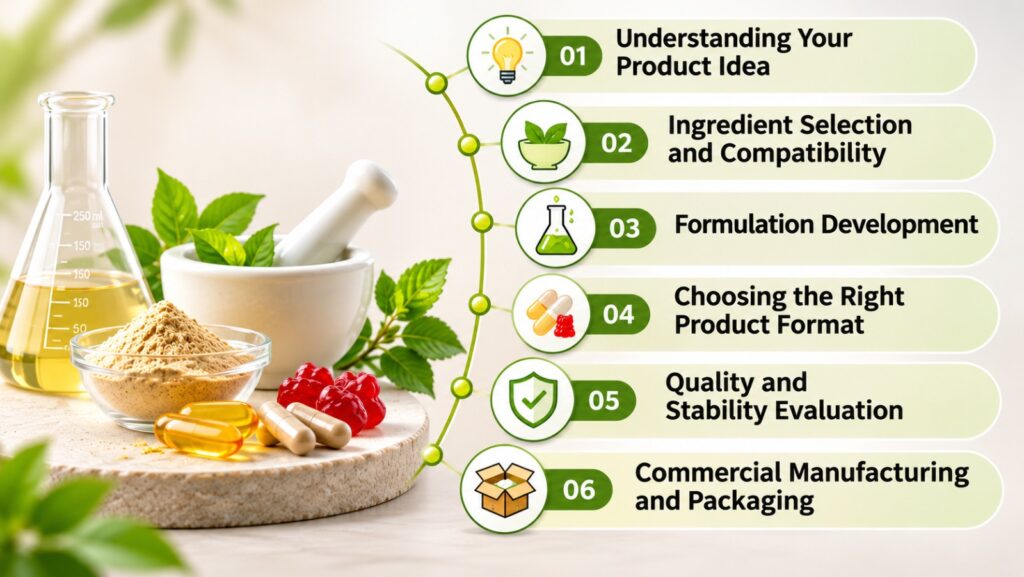
Developing a custom supplement involves more than selecting ingredients and sending them for production. Each stage, from understanding your idea to final packaging, helps ensure the product is practical to manufacture and meets the required quality standards.
Step 1: Understanding Your Product Idea
The process starts with understanding your vision. You share your product concept, preferred ingredients, target audience, nutritional requirements and desired format. For example, if you want to launch a plant-based protein blend with added vitamins and minerals, the manufacturer evaluates these requirements before moving ahead.
Step 2: Ingredient Selection and Compatibility
Not every ingredient works well with every other ingredient. The manufacturer evaluates factors such as ingredient stability, solubility, taste, dosage and possible interactions. Based on this assessment, suitable ingredient forms or alternatives may be recommended to improve the formulation.
Step 3: Formulation Development
Once the ingredients are finalised, the formulation is developed by determining their proportions, suitable excipients and processing requirements. The aim is to create a balanced formula that meets your product specifications and can be manufactured consistently.
Step 4: Choosing the Right Product Format
Next, the manufacturer helps select a suitable format, such as tablets, capsules, powders or gummies. The choice depends on the ingredients, serving size and manufacturing feasibility.
Step 5: Quality and Stability Evaluation
The formulation undergoes relevant quality checks and stability assessment to evaluate its safety, consistency and ability to maintain quality throughout its intended shelf life. Read the FDA’s Official Manufacturing Guide
Step 6: Commercial Manufacturing and Packaging
Once everything is finalised, the product moves into commercial production. It is manufactured, quality-checked and packed according to the agreed specifications and brand requirements.
4. Which Supplement Format Should You Choose for Your Custom Formula?
An interesting part of custom supplement development is deciding how customers will consume the finished product.
The same general nutritional concept may be explored through different dosage forms, but not every formula is suitable for every format.
| Supplement format | Best suited for | Important formulation consideration |
| Tablets | Multivitamins, minerals and selected nutrient combinations | Compression properties, ingredient compatibility and disintegration |
| Capsules | Vitamins, botanical extracts and selected powder blends | Fill capacity, ingredient properties and capsule compatibility |
| Softgels | Suitable oils and oil-based ingredients | Oil compatibility, shell characteristics and leakage control |
| Powders | Protein blends, nutrition mixes and selected functional formulations | Solubility, taste, flow properties and moisture control |
| Gummies | Selected vitamins and suitable wellness ingredients | Heat sensitivity, moisture, texture and ingredient stability |
The final choice depends on the actual formula, ingredient quantities, manufacturing capabilities, intended consumers and product requirements.
For example, a product containing oil-based ingredients may be more appropriate for a softgel format, while a larger nutritional blend may be more practical as a powder.
The important thing is not to choose a format simply because it is popular. Choose one that works for your formulation and offers a suitable experience to your customers.
5. How Much Does Custom Supplement Formulation Cost?
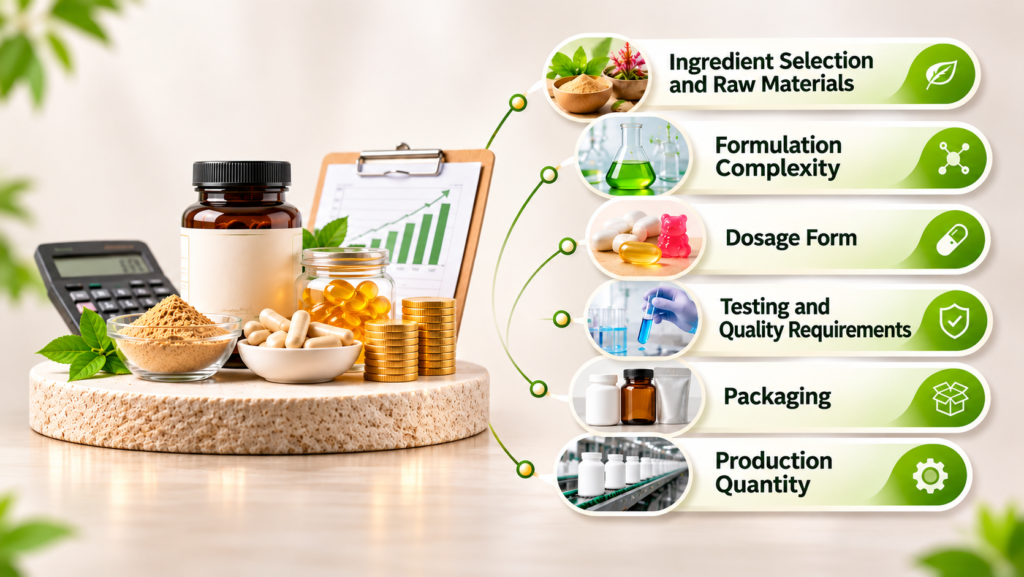
Custom supplement formulation costs vary depending on the ingredients, product complexity and manufacturing requirements.
Some of the major cost factors include:
Ingredient selection and raw materials: Specialised botanical extracts, branded ingredients, standardised materials and imported ingredients may have different sourcing costs.
Formulation complexity: A simple vitamin combination and a multi-ingredient formulation with specific technical requirements involve different development efforts.
Dosage form: Tablets, capsules, softgels, powders and gummies require different materials, equipment and manufacturing processes.
Testing and quality requirements: The testing programme depends on the product’s ingredients, specifications, risks and regulatory requirements.
Packaging: Bottles, jars, sachets, blister packs and specialised packaging materials can influence the final product cost.
Production quantity: Batch size and minimum order quantities can affect production economics and per-unit pricing.
Ask for a detailed quotation covering development, ingredients, manufacturing, testing and packaging. This helps you plan your budget and avoid unexpected costs.
6. What Regulatory Requirements Should You Consider in India?
Developing a custom supplement involves more than choosing the right ingredients. The formulation must also comply with applicable Indian food safety regulations.
In India, the Food Safety and Standards Authority of India (FSSAI) regulates health supplements and nutraceuticals under the Food Safety and Standards (Health Supplements, Nutraceuticals, Food for Special Dietary Use, FSSAI’s 2016 regulations outline the requirements for health supplements and nutraceuticals in India.
Before finalising your formula, consider these key requirements:
- Ingredient approval: Ensure the ingredients are permitted for the intended product category.
- Composition: Check applicable limits and requirements for ingredient quantities.
- Product claims: Avoid unsupported disease prevention or treatment claims.
- Labelling: Follow applicable packaging and labelling requirements.
- Licensing: Ensure the manufacturing and business arrangements meet relevant FSSAI requirements.
Considering these requirements early can help avoid regulatory issues and unnecessary changes during product development.
7. How Bliss Life Sciences Helps Turn Custom Supplement Ideas Into Products
Turning a supplement idea into a finished product requires the right formulation expertise and manufacturing support. At Bliss LifeSciences, businesses can explore custom nutraceutical development with support in ingredient selection, botanical guidance, flavour development, odour masking and product stability. The company offers manufacturing options across tablets, capsules, softgels and powders to suit different product requirements.
Whether you are developing a new supplement or expanding your existing product range, the first step is to discuss your concept and manufacturing needs. Connect with Bliss Life Sciences to explore how your custom supplement idea can move towards production.
Explore = How to Expand an Existing Wellness Brand With Third-Party Manufacturing
Frequently Asked Questions (FAQs)
1. Can a manufacturer make supplements using my own formula?
Yes. Manufacturers can evaluate your formula and produce it if it meets the required standards.
2. What is the cost of custom supplement manufacturing?
It depends on ingredients, formulation, dosage form, packaging and order quantity.
3. How long does custom supplement development take?
It depends on formulation complexity, ingredient availability, testing and production requirements.
4. Can I manufacture supplements under my own brand name?
Yes. Third-party manufacturers can develop and produce supplements under your brand name.
Final Thoughts:
Turning a supplement idea into a finished product requires the right ingredients, formulation expertise and manufacturing support. Partnering with an experienced nutraceutical manufacturer can help simplify the process while ensuring attention to quality and regulatory requirements.
Explore = How to Choose the Right Nutraceutical Manufacturer in India