


Launching a shilajit resin brand involves more than attractive packaging and competitive pricing. Raw-material sourcing, product authenticity, laboratory testing, packaging and regulatory compliance all play an important role in delivering a reliable product. For entrepreneurs, private-label manufacturing offers an opportunity to build their own brand without establishing a complete manufacturing facility.
Choosing the right partner requires more than comparing quotations. Businesses need to evaluate quality standards, batch documentation, testing procedures and manufacturing capabilities before making a decision. This guide explores how to assess private label shilajit resin manufacturers, verify product quality and select a suitable partner for long-term business growth.
Quick Overview
Private-label shilajit resin manufacturing enables businesses to launch products under their own brand through an agreed manufacturing partnership. Before selecting a manufacturer, evaluate raw-material traceability, laboratory testing, batch documentation and product consistency. It is also important to confirm regulatory classification, labelling requirements, packaging suitability and commercial terms before production begins. Ultimately, choose a manufacturing partner based on verified capabilities, transparent processes and documented quality standards rather than marketing claims alone.
What Is Private-Label Shilajit Resin Manufacturing?
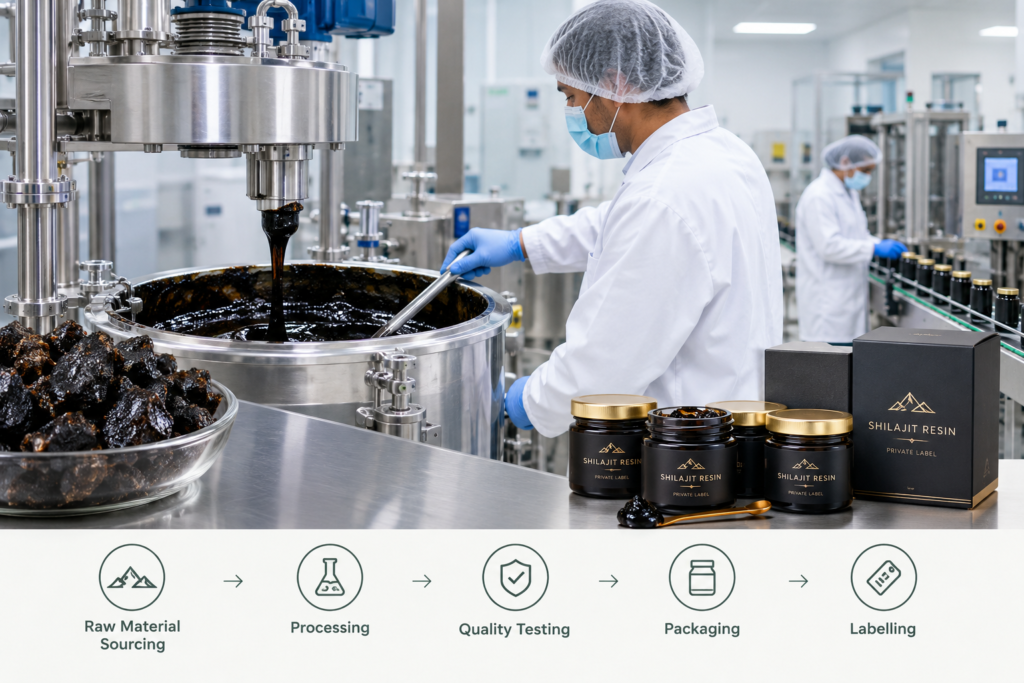
Private-label shilajit resin manufacturing allows businesses to sell products under their own brand without setting up their own manufacturing facility. Depending on the agreement, manufacturers may support raw-material sourcing, processing, quality testing, packaging and labelling.
This model helps startups enter the supplement market and enables established brands to expand their product range. However, services vary by manufacturer: some supply ready-to-brand products, while others offer customisation or contract manufacturing.
How to Evaluate Private-Label Shilajit Resin Manufacturers
1. Verify Raw-Material Traceability
Choose a manufacturer that can explain where its shilajit comes from and how each batch is tracked. Transparent sourcing helps ensure accountability and makes quality issues easier to investigate.
Ask potential partners:
- Can you identify the raw-material source and incoming batch?
- How are suppliers assessed and approved?
2. Review Laboratory Testing
Request a batch-specific Certificate of Analysis (CoA) to assess product identity, heavy metals, microbiological quality and other relevant contaminants. Check whether the results meet defined specifications.
- Check how the resin was tested, what the results show and whether the lab is qualified. The NABL directory of accredited laboratories can help you verify laboratory accreditation and identify laboratories for further assessment.
- Ensure the testing plan reflects the product’s risks and applicable requirements.
3. Check Batch Consistency
Reliable quality means more than passing a single test. Manufacturers should follow clear specifications and documented quality-control procedures.
- Ask how batch consistency is monitored and quality deviations are handled.
- Review relevant stability evidence to support the proposed shelf life.
4. Confirm Manufacturing Capabilities
Verify who actually processes the resin and whether the manufacturer offers complete private-label services. Check the facility’s approvals and ensure compliance with applicable FSSAI regulations for health supplements and nutraceuticals before finalising the agreement.
- Clarify whether testing, filling, labelling and packaging are included.
- Check whether any manufacturing activities are subcontracted.
5. Choose Suitable Packaging
Packaging should protect the resin, minimise leakage and provide a convenient customer experience. Consider container suitability, closure quality and storage requirements.
- Ask which packaging materials are suitable for the product.
- Confirm how leakage prevention and packaging compatibility are assessed.
What to Compare Before Selecting a Private-Label Shilajit Resin Manufacturer
Use the following checklist when evaluating quotations and supplier proposals. It helps you judge suppliers by the proof they provide, not just the promises they make.
| Evaluation criteria | Questions to ask | Evidence to request |
| Raw-material sourcing | Can each incoming lot be traced to its source? | Supplier records and lot-traceability documentation |
| Product identity | How is the material’s identity verified? | Relevant test methods, results, and product specifications |
| Contaminant testing | Which contaminants are assessed, and why? | Batch-specific reports and applicable acceptance criteria |
| Quality consistency | How are batch variations managed? | Approved specifications, release records, and deviation procedures |
| Regulatory readiness | Which rules apply to the proposed product? | Relevant licences, product documents, and label review |
| Packaging | Is the container suitable for the resin and intended shelf life? | Packaging specifications and supporting compatibility or stability evidence |
| Commercial terms | What is included in the quotation? | Written scope, minimum order quantity, lead time, and payment terms |
| Ongoing supply | How are changes, complaints, and quality issues handled? | Change-control arrangements and documented complaint procedures |
Compare suppliers against the same requirements. If one quotation includes testing and retail packaging while another covers only bulk material, the headline prices are not directly comparable.
How the Private-Label Manufacturing Process Works
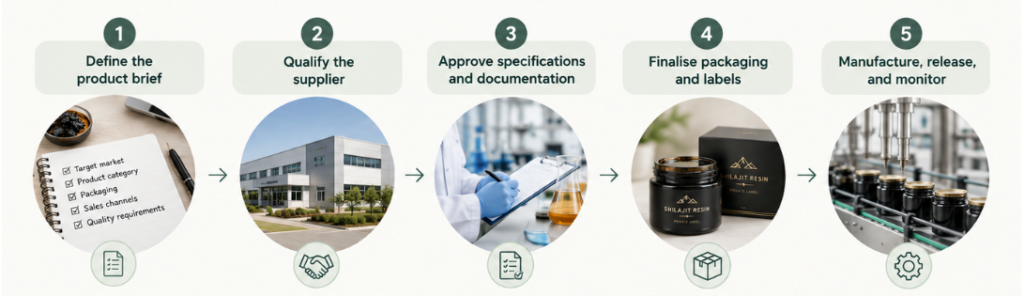
A well-managed project should move through defined stages, with clear approval points before money is committed to large-scale production.
Step 1: Define the product brief
Identify your target market, intended product category, preferred packaging, sales channels, and quality requirements. Make sure the product type and marketing claims meet the rules for your target market.
Step 2: Qualify the supplier
Identify the manufacturer, review its approvals, and assess how it monitors materials and maintains product quality.
Step 3: Approve specifications and documentation
Agree on the product specification, testing requirements, acceptance criteria, batch documentation and responsibilities for quality release.
Step 4: Finalise packaging and labels
Review packaging suitability, label artwork, required declarations, claims, storage instructions, and market-specific compliance before approval.
Step 5: Manufacture, release and monitor
Confirm the agreed production process, required testing, batch-release documentation, distribution arrangements and procedures for handling complaints or quality issues.
The exact sequence depends on the product, contract, regulatory category and manufacturer’s capabilities. Not all suppliers handle every stage of the process.
Explore: How to Select a Private Label Nutraceutical Partner for Long-Term Growth
Common Mistakes That Can Create Problems After Launch
Choosing on price alone
A low quotation may exclude laboratory testing, retail packaging, label support, or documentation. Compare the full cost of delivering a compliant, sale-ready product, not simply the cost per kilogram of resin.
Accepting a generic certificate of analysis
A report that does not identify the relevant batch or does not show suitable methods and results may provide limited assurance. Request records specific to the material or product being purchased.
Assuming a supplier is the manufacturer
A distributor may be a legitimate business partner, but you should know who performs the manufacturing and who is responsible for quality decisions. Verify the supply chain rather than relying on the wording of a sales page.
Approving the label before confirming the product category
Changing claims, declarations, or packaging after artwork approval can delay a launch and increase costs. Confirm the product’s regulatory position before printing commercial quantities.
Treating “natural” as proof of safety
Natural origin does not establish the absence of contaminants or adulteration. The NCCIH review of Ayurvedic medicine safety highlights potential heavy-metal concerns associated with some Ayurvedic preparations, reinforcing the importance of appropriate testing and traceability when evaluating product quality.
Ignoring what happens after delivery
Agree in advance how shortages, damaged packaging, suspected quality defects, customer complaints, and product recalls will be managed. These responsibilities become especially important when your brand name appears on the product.
Why Consider Bliss Life Sciences?
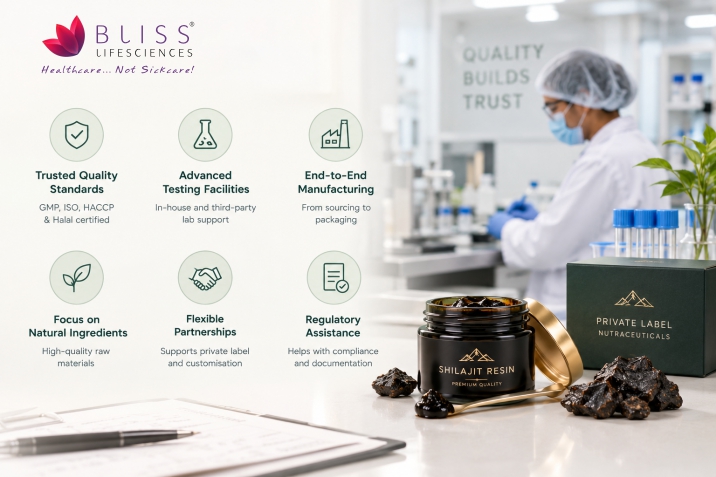
Bliss Lifesciences LLP helps businesses develop and launch nutraceutical and wellness products through services such as formulation, production, packaging, and brand customisation. It also manufactures shilajit gummies for brands looking to expand their supplement range.
For businesses planning to launch a shilajit product, Bliss Lifesciences may be a starting point for discussing product development and manufacturing needs. However, its published services do not specifically confirm private-label shilajit resin manufacturing. Contact the team to verify resin-specific capabilities, minimum order quantities, testing requirements, packaging options, and documentation before proceeding.
Frequently Asked Questions
1. How do I choose reliable private-label shilajit resin manufacturers?
Look for verified manufacturing capabilities, raw-material traceability, appropriate laboratory testing, consistent product specifications, and transparent pricing.
2. How can I verify shilajit resin quality?
Request a batch-specific Certificate of Analysis (CoA) covering product identity and relevant contaminants. Check the test results, methods, and laboratory credentials.
3. What sets a product manufacturer apart from a supplier?
A manufacturer makes the product, whereas a supplier may obtain it from another company and sell it to buyers. Check who is responsible for manufacturing and maintaining quality standards.
4. What is the minimum order quantity for private-label shilajit resin?
Minimum order quantities vary by manufacturer, packaging type and production requirements. Ask for a detailed price quote covering minimum order quantities and any extra charges.
Conclusion: Choose a Manufacturing Partner on Evidence, Not Promises
Building a successful shilajit resin brand starts with choosing the right manufacturing partner. Prioritise raw-material traceability, laboratory testing, consistent quality, suitable packaging and regulatory compliance before placing an order.
Compare manufacturers based on documented capabilities, transparent communication and clear commercial terms. Bliss LifeSciences offers private-label and contract manufacturing services, but its specific shilajit resin manufacturing capabilities should be confirmed directly.