


A nutritional supplement may come as a capsule, powder, gummy, softgel, or sachet but its development involves much more than the finished product suggests. Ingredient selection, formulation, quality, stability, and manufacturing all shape the final supplement.
So, what are nutritional supplements? They are products designed to complement the diet with nutrients or other dietary ingredients such as vitamins, minerals, amino acids, botanicals, or probiotics. This guide explores their types, uses, quality considerations, and role in modern nutraceutical manufacturing.
Quick Overview
Nutritional supplements are products intended to add specific nutrients or other dietary ingredients to the diet.
They can contain vitamins, minerals, botanicals, amino acids, probiotics, and other ingredients.
Common formats include tablets, capsules, powders, gummies, softgels, and liquids.
Their quality, safety, intended use, and permitted claims depend on the formulation and applicable regulations.
What Are Nutritional Supplements?
A nutritional supplement is a product designed to complement the diet by providing specific nutrients or other dietary ingredients. These may include vitamins, minerals, amino acids, botanicals, probiotics, or other permitted ingredients.
Supplements are available in various forms, including tablets, capsules, powders, gummies, softgels, and liquids. The FDA recognizes dietary supplements as products intended to supplement the diet, while in India, FSSAI regulates categories such as Health Supplements and Nutraceuticals.
Because regulations vary by country, the exact classification, ingredients, labeling, and permitted claims of a nutritional supplement depend on the market where it is manufactured and sold.
Explore = What Are Dietary Supplements? How They Support Your Diet
Why Are Nutritional Supplements Used?
A balanced diet is the starting point for good nutrition, but individual nutrient needs can differ. Nutritional supplements may be used to complement dietary intake by providing specific vitamins, minerals, proteins, botanicals, probiotics, or other dietary ingredients.
However, supplements are not automatically necessary for everyone. Their purpose, ingredient profile, dosage, evidence, and suitability should be considered before use. The NIH Office of Dietary Supplements provides evidence-based information on vitamins, minerals, botanicals, and other supplement ingredients.
Before choosing a supplement, consider:
- What does it contain?
- What is it intended to provide?
- Is there reliable evidence for its use?
- Could it interact with medicines or other supplements?
The goal is not simply to take more supplements, but to choose products that have a clear and appropriate nutritional purpose.
Types of Nutritional Supplements
The supplement category is broad, so looking at products by their nutritional focus can make the landscape easier to understand.
| Supplement category | Common ingredients | Typical format | What it generally provides |
| Vitamin supplements | Vitamin C, D, B vitamins, etc. | Tablets, capsules, gummies, liquids | Specific vitamins |
| Mineral supplements | Calcium, iron, magnesium, zinc | Tablets, capsules, powders, liquids | Specific minerals |
| Multivitamin/mineral products | Multiple vitamins and minerals | Tablets, capsules, powders | A combination of nutrients |
| Protein products | Whey, plant proteins, protein blends | Powders, ready-to-mix products | Dietary protein |
| Botanical supplements | Herbs and plant extracts | Capsules, powders, liquids | Selected botanical ingredients |
| Probiotic products | Selected live microorganisms | Capsules, powders, food formats | Live microbial ingredients |
| Nutrient premixes | Blends of vitamins, minerals or functional ingredients | Premix powders and application-specific forms | A controlled ingredient blend for incorporation into a finished product |
This is a general educational classification. A product’s regulatory status and permitted claims can vary according to its formulation, intended use, and market.
Nutritional Supplements vs. Nutraceuticals: What’s the Difference?

The words supplement and nutraceutical are often used together, particularly in the wellness industry, but they should not automatically be treated as synonyms.
A nutritional supplement generally refers to a product designed to supplement dietary intake.
“Nutraceutical,” meanwhile, is an industry term used broadly for products or ingredients associated with nutritional and health-related applications. Its precise regulatory meaning can vary depending on the jurisdiction.
In India, this distinction is particularly relevant because FSSAI has a dedicated regulatory framework covering Health Supplements and Nutraceuticals.
For businesses developing products for the Indian market, understanding the applicable category is therefore more than a terminology exercise. It can affect formulation, ingredient selection, labeling, claims, documentation, and compliance.
Common Forms of Nutritional Supplements
Supplementation has moved well beyond the traditional tablet.
Today, products may be formulated as:
- Tablets
- Capsules
- Softgels
- Powders
- Sachets
- Gummies
- Liquids
- Bars
- Ready-to-use or ready-to-mix products
The FDA lists tablets, capsules, softgels, powders, bars, gummies, and liquids among common dietary supplement forms.
The choice of format is not simply a matter of appearance.
For a formulation team, dosage form can influence:
- Ingredient compatibility
- Stability
- Serving size
- Processing requirements
- Taste and mouthfeel
- Packaging
- Consumer convenience
- Shelf-life considerations
For example, an ingredient that performs well in a dry powder may require a different formulation strategy when developed for a liquid or gummy.
That is where formulation expertise becomes particularly important.
Nutritional Supplements vs. Medicines
Nutritional supplements and medicines are not the same. Their definitions, regulatory requirements, permitted claims, and approval processes can differ by country. In the U.S., for example, the FDA regulates dietary supplements as a category of food rather than drugs and does not approve them for safety and effectiveness before marketing in the same way it approves medicines.
This distinction is especially important for supplement brands. Product claims must align with the applicable regulations, making regulatory review an essential part of formulation and product development, rather than a step left until after manufacturing.
How to Evaluate a Nutritional Supplement
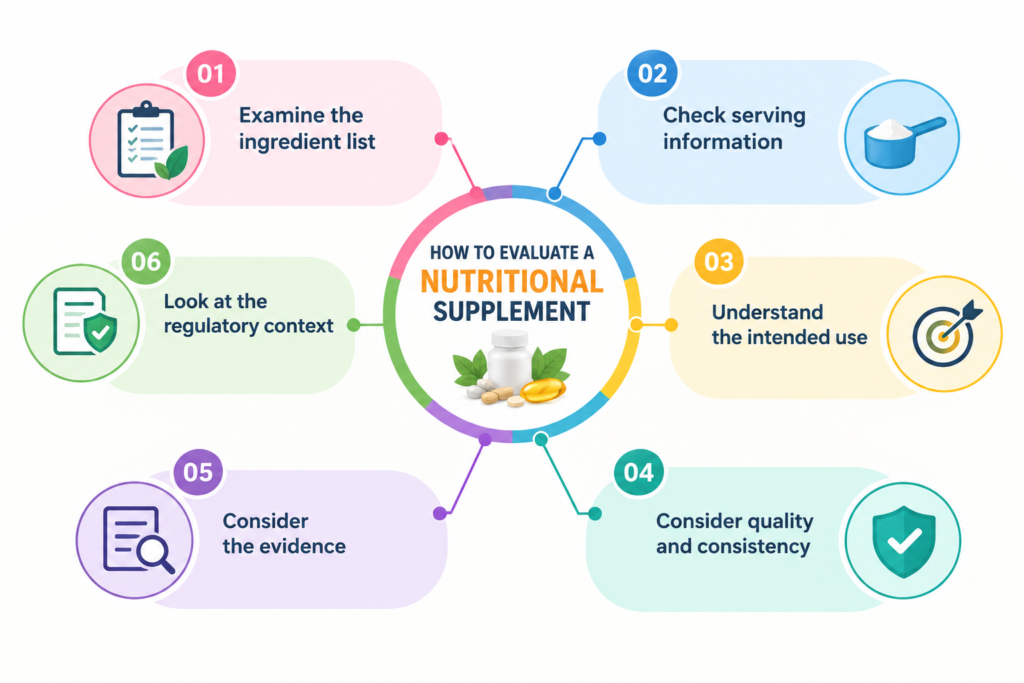
A good-looking label tells only part of the story.
Whether you are a consumer comparing products or a brand evaluating a formulation, several details deserve attention.
1. Examine the ingredient list
Know what is actually included in the formulation.
Look beyond front-of-pack marketing language and review the ingredients and their quantities.
2. Check serving information
The amount per serving can be more informative than the headline ingredient quantity.
A product’s serving size, number of servings, and amount of each ingredient should be considered together.
3. Understand the intended use
A supplement should have a clear nutritional purpose.
Avoid assuming that a longer ingredient list automatically represents a better formulation.
4. Consider quality and consistency
For manufactured products, ingredient identity, purity, testing, blending, stability, traceability, and batch consistency all matter.
5. Consider the evidence
The scientific evidence supporting different ingredients can vary considerably.
Evidence-based resources on individual supplement ingredients can serve as a useful starting point when researching a specific nutrient or ingredient.
6. Look at the regulatory context
A product sold in India may be subject to different requirements from one marketed in the United States or another country.
That makes country-specific regulatory expertise particularly valuable for manufacturers and brands.
Final Thoughts
Nutritional supplements go far beyond vitamins in a bottle. From capsules and powders to gummies and premixes, their quality depends on ingredient selection, formulation, stability, manufacturing, evidence, and regulatory compliance.
For consumers, informed choices matter; for brands, so does working with the right manufacturing partner. As the nutraceutical industry evolves, companies such as Bliss Life Sciences help bridge the gap between nutrition concepts and reliable, scalable supplement formulations.
Explore = Supplement Manufacturing Industry in India: Key Insights and Top Manufacturers
Frequently Asked Questions
What are nutritional supplements?
Nutritional supplements are products designed to complement the diet with nutrients or other dietary ingredients, such as vitamins, minerals, amino acids, botanicals, or probiotics.
What are examples of nutritional supplements?
Common examples include multivitamins, vitamin D, calcium, magnesium, protein supplements, probiotics, botanical supplements, and specialized nutrient blends.
Can nutritional supplements replace a healthy diet?
No. Supplements are intended to complement the diet, not replace a varied and balanced food intake.
Are nutritional supplements safe to take every day?
It depends on the specific supplement, ingredients, dosage, and individual needs. Some products may interact with medicines or cause unwanted effects, so professional guidance can be appropriate.
How are nutritional supplements manufactured?
Supplement manufacturing typically involves ingredient selection, formulation, blending or processing, quality testing, packaging, and regulatory checks. The process varies according to the ingredients and final dosage form.